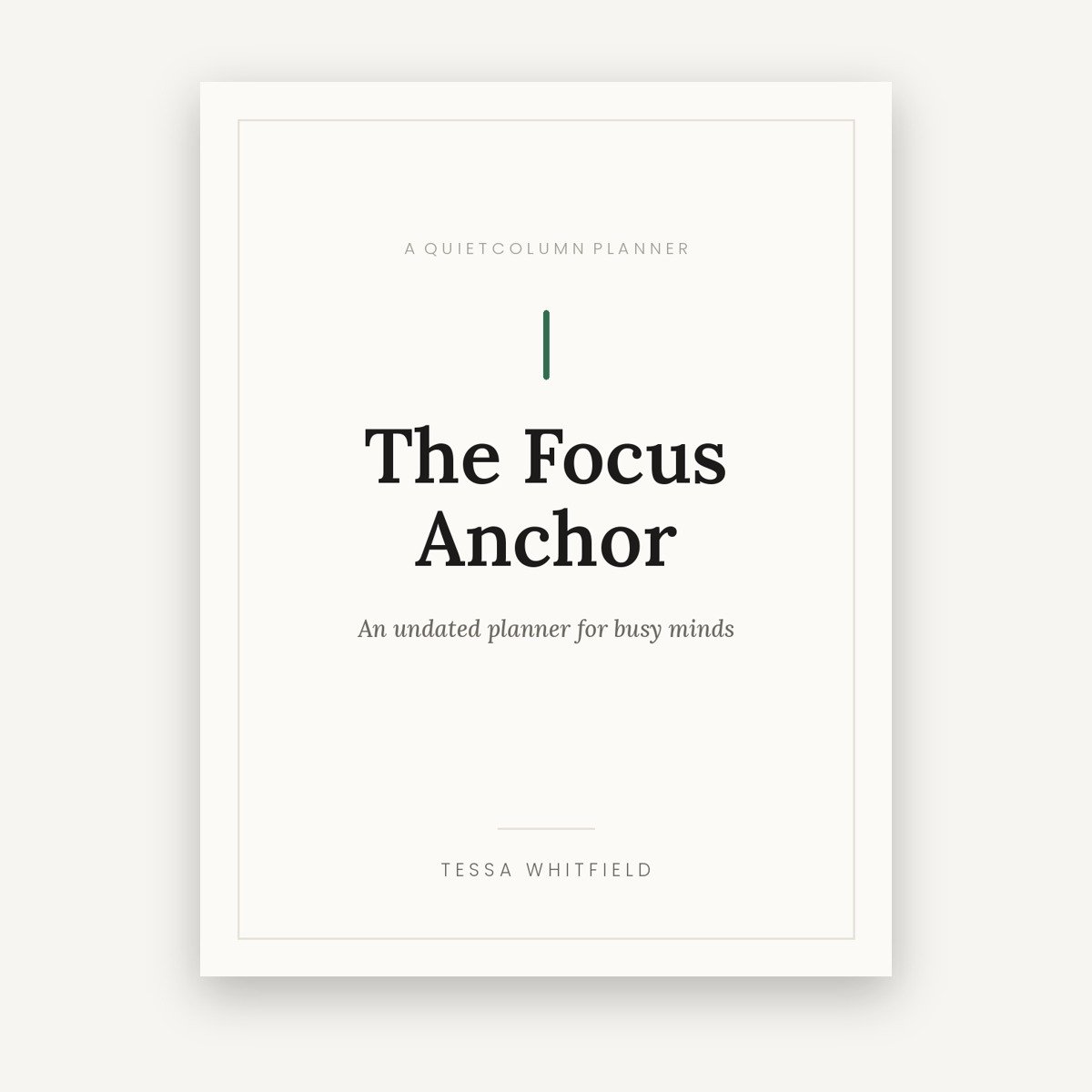
Book one — by Tessa Whitfield
The Focus Anchor
An undated planner built around a single question each morning: what is today actually about? Everything else on the page arranges itself around that answer.
$12.99 · printed, shipped and returnable through Amazon.
Look inside
How it is built
Thirteen weekly cycles, each built from three page types. These are photographs of the actual pages.
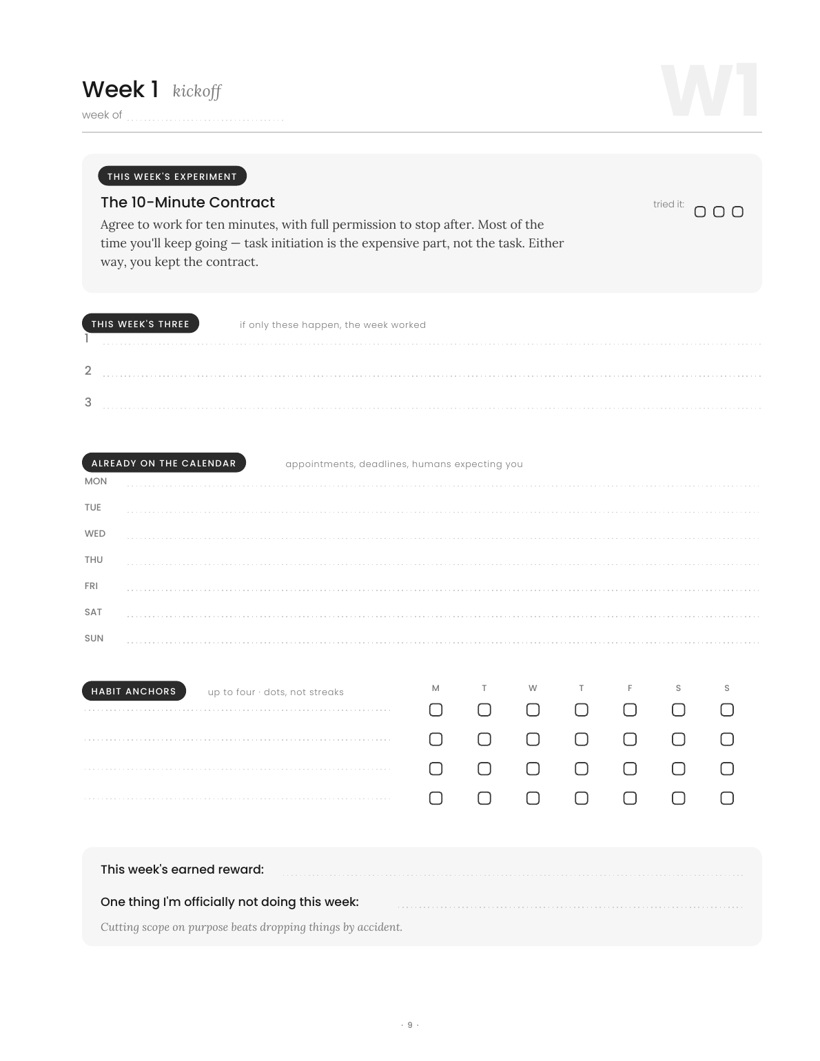
Each week starts
The week kickoff
One experiment to try, three things that would make the week count, and habit anchors tracked as dots — not streaks you can break.
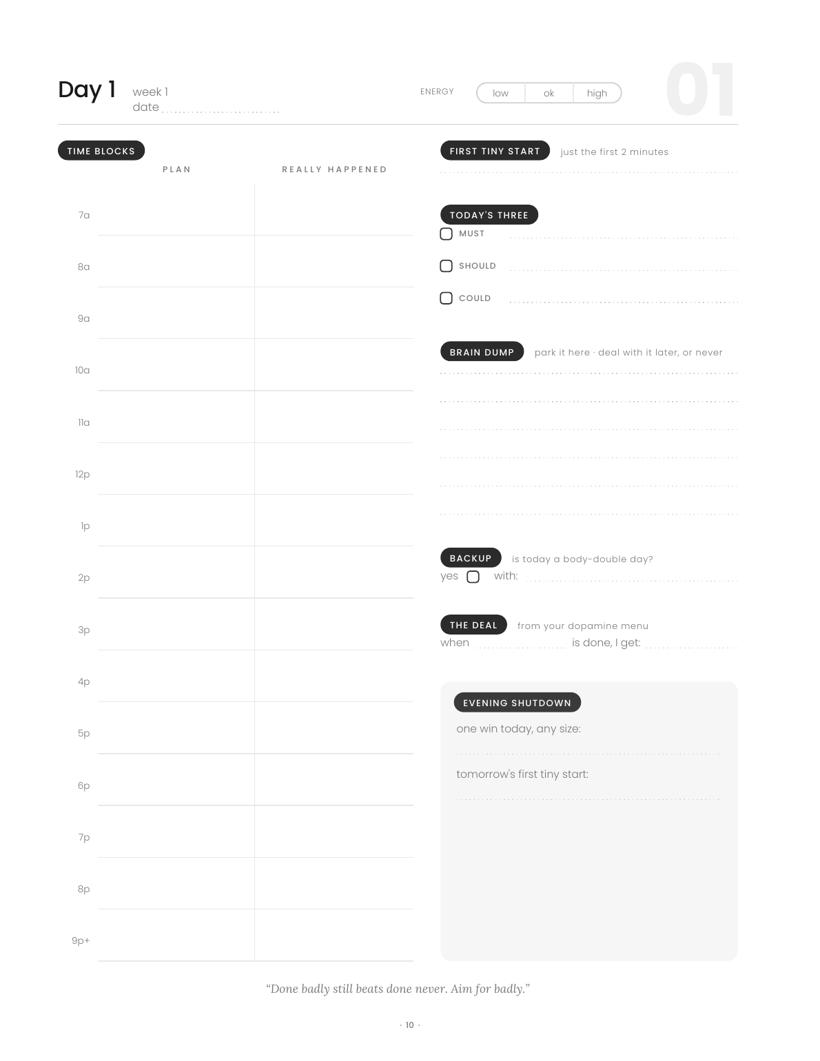
Each day
The daily page
Time blocks with a plan column and a "really happened" column, a first tiny start, today's three, and a brain dump that parks everything else.
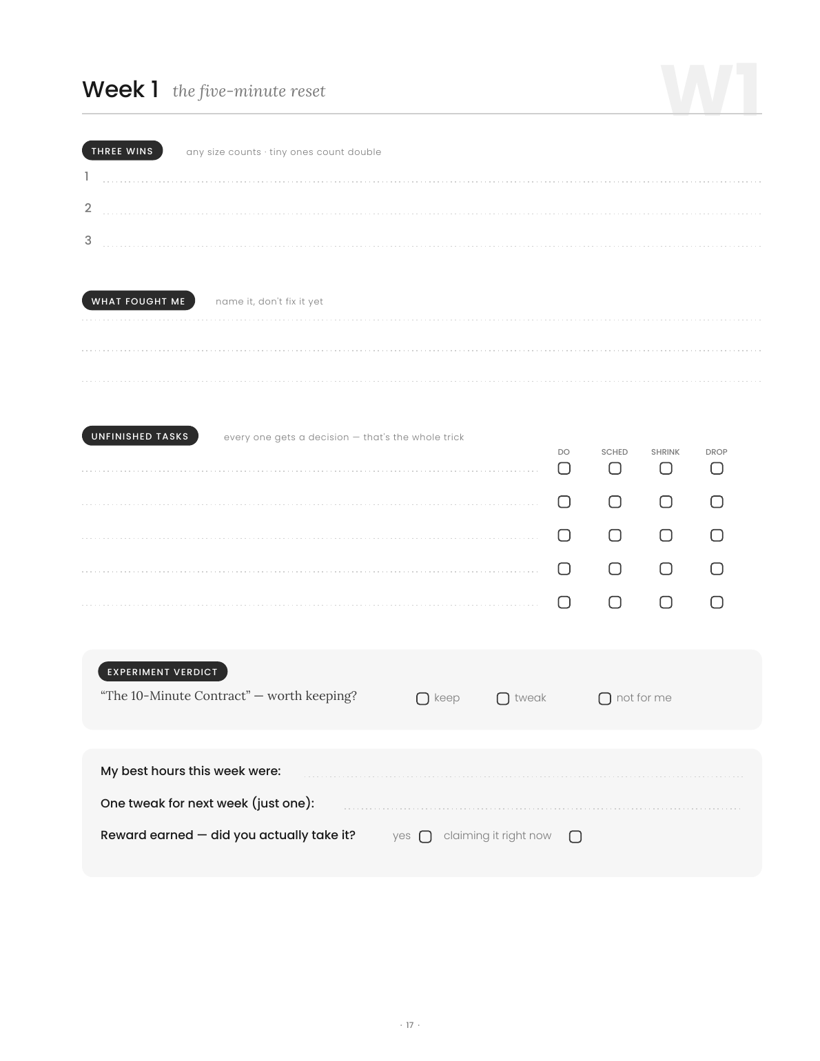
Each week ends
The five-minute reset
Three wins of any size, what fought you, and every unfinished task gets a decision — do, schedule, shrink, or drop.
Who it suits
For people who've quit a planner before.
You've bought one, used it beautifully for nine days, missed a week, and never opened it again — because the book made that gap feel like a failure rather than a Tuesday.
The Focus Anchor is undated on purpose. You start on whatever day you pick it up, and if you put it down for a month you start again on the next blank page. There is nothing in the book that knows you were gone.
Plainly: this is a paper planner — thoughtfully designed, informed by well-established ideas about attention, routine, and getting started again after a gap. It is not therapy, not treatment, and not a substitute for care from a qualified professional.
The other book
The Focus Anchor shapes the day. Set It Down is its evening counterpart — a guided journal for overthinkers, built from real CBT thought records and gentle rituals, on the same one-calm-page principle.
Questions people ask
Is it dated? Do I have to start in January?
No dates anywhere. You write the date when you use a page. Start on a random Wednesday in the middle of the year — the book neither knows nor cares.
What happens when I skip a week?
Nothing. That's the design. There are no pre-printed days sitting there unused, so a gap leaves no evidence. When you come back, the five-minute reset closes each week — and because nothing is dated, you just start the next kickoff page whenever you're back. No reckoning.
Why so big? 8.5 × 11 is a lot of desk.
Because cramped columns are why most planners fail. At this size a day's column fits full sentences, the margins hold the stray thoughts, and the book opens flat enough to write on both pages. It's a desk book, not a bag book — that's a deliberate trade.
How do I buy it, and what if it isn't for me?
Through Amazon — their checkout, their shipping, their return policy applies as with any book they print. If the format doesn't suit you, the free sampler below exists precisely so you can find that out for the price of a sheet of printer paper.
Who is Tessa Whitfield?
The pen name the QuietColumn books are written under — one person, one studio, based in Texas. More on the about page.
Try three pages first
A free PDF sampler — the week kickoff, a daily page and the five-minute reset, straight from the book. Print one, use it for a week, and see whether the format suits how you actually work before buying anything.
One email when something new is finished. Unsubscribe in one click.